
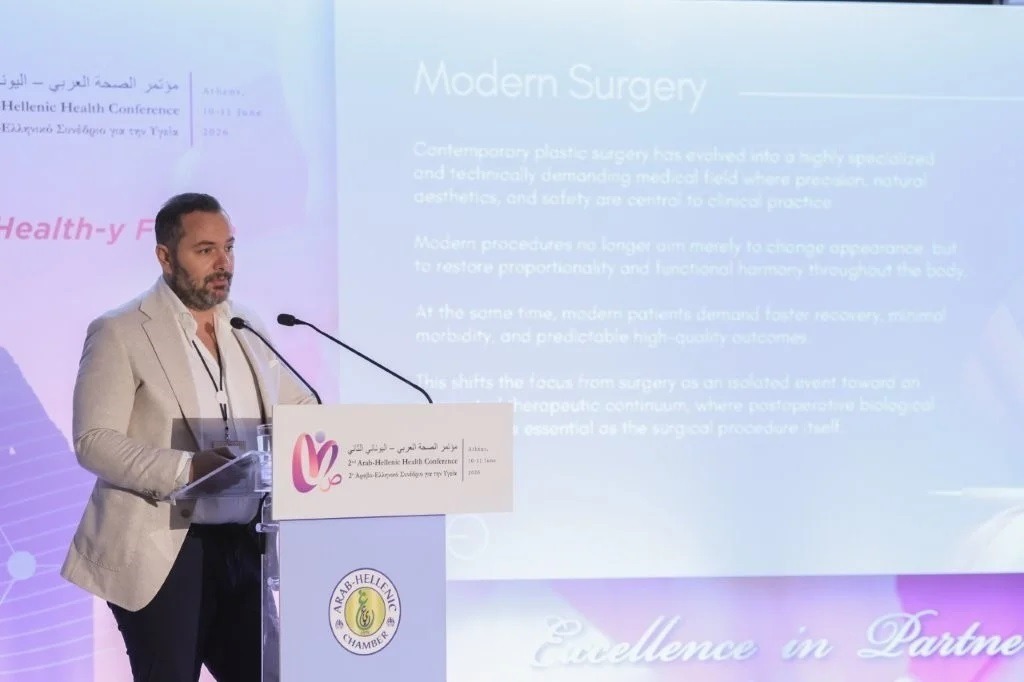
Event Title: 2nd Arab–Hellenic Healthcare Conference
Date: June 2026
Location: Divani Caravel
2nd Arab–Hellenic Healthcare Conference
Modern surgery has reached a critical stage in its evolution. It is no longer enough for an operation to be completed successfully from a technical perspective. True success is assessed through the quality of healing, functional recovery, fewer complications and the patient’s faster return to everyday life.
This was the central message of the presentation delivered at the 2nd Arab–Hellenic Healthcare Conference, which focused on surgical practice in biological recovery and the role of hyperbaric oxygen therapy in contemporary clinical care.
The audience’s warm response, the thoughtful questions and the discussions that followed highlighted something extremely important: the medical community is increasingly seeking therapeutic approaches that focus not only on treating the injury itself, but also on providing biological support to help the body heal more effectively, more thoroughly and with better functional outcomes.
From Surgical Success to Biological Recovery
Every surgical procedure also presents the body with a biological challenge. Following surgery, tissues require adequate blood flow, oxygenation, cellular activation and microcirculatory support for the healing process to begin and progress correctly.
Healing is not a passive process. It is a complex mechanism requiring energy, oxygen, cellular cooperation, a vascular response and tissue regeneration. Within this context, the concept of biological recovery assumes particular importance.
Modern surgery does not end in the operating theatre. It continues throughout the postoperative period, influencing scar quality, tissue viability, functional recovery and, ultimately, the patient’s overall experience.
The Role of Tissue Oxygenation in Healing
Oxygen is a fundamental factor in tissue healing. It participates in critical biological processes, including energy production, collagen synthesis, angiogenesis, fibroblast function and defence against infection.
When tissue oxygenation is inadequate, healing may be delayed or progress poorly. This is often observed in difficult-to-heal wounds, areas with impaired blood flow, tissues affected by radiation, chronic ulcers and complex reconstructive procedures.
Supporting oxygenation is not merely an additional consideration. It is a fundamental requirement for activating the mechanisms of regeneration and repair.
What Is Hyperbaric Oxygen Therapy?
Hyperbaric oxygen therapy, internationally known as HBOT, is a therapeutic method in which the patient breathes oxygen in an environment of increased atmospheric pressure inside a specially designed hyperbaric chamber.
This increases the amount of oxygen dissolved in the plasma, enabling it to reach tissues where oxygen availability is limited. Greater oxygen availability may support microcirculation, angiogenesis, the activity of cells involved in healing and the overall process of tissue repair.
In contemporary clinical practice, HBOT should not be regarded as a stand-alone solution. It is an adjunctive therapeutic tool incorporated into a comprehensive medical plan according to the indication, the patient’s condition and the treatment objectives.
HBOT and Postoperative Recovery
The postoperative period is critical. It is the stage during which the body must transform the surgical intervention into genuine recovery.
Hyperbaric oxygen therapy may provide supportive benefits in selected cases where tissue oxygenation, microcirculation and healing are essential to the final outcome. Its effects are associated with improving oxygen availability within tissues, supporting neovascularisation, regulating the inflammatory response and strengthening the biological mechanisms of regeneration.
For the surgical patient, this represents a more holistic approach to recovery. The objective is not simply for a wound to close, but for it to heal correctly. It is not merely for an operation to be completed, but for function, tissue quality and the patient’s everyday life to be restored.
Applications in Plastic and Reconstructive Surgery
In plastic and reconstructive surgery, the quality of tissue perfusion and oxygenation is often decisive. Flaps, grafts, complex reconstructions and areas with compromised blood supply require particular biological support.
HBOT may serve as a valuable adjunctive tool in selected cases, particularly when there is an increased risk of tissue hypoxia or delayed healing. The ability to enhance oxygenation in tissues whose viability is at risk may support the recovery process and contribute to a better final outcome.
Modern reconstructive surgery is not concerned solely with anatomical restoration. It also seeks to restore tissue vitality, function and quality.
Difficult-to-Heal Wounds and Chronic Tissue Hypoxia
Difficult-to-heal wounds represent one of the greatest challenges in everyday clinical practice. Chronic ulcers, wounds with impaired blood flow, complications following surgery and radiation-related tissue injuries require a multifactorial approach.
In such cases, tissue hypoxia may act as a barrier to healing. Improving tissue oxygenation may help the body reactivate mechanisms that have slowed down or become dysregulated.
Hyperbaric oxygen therapy is incorporated into a comprehensive strategy that may also include surgical debridement, antimicrobial treatment, specialist wound care, nutritional support and monitoring of the patient’s overall condition.
Regenerative, Rehabilitation and Longevity Medicine: The New Direction of Healthcare
The medicine of the future is not limited to treating disease. It focuses on regeneration, functional recovery, preventing deterioration and preserving quality of life.
The concepts of regenerative medicine, rehabilitation medicine and longevity medicine converge on a common principle: the need to support the body’s biological potential.
Hyperbaric oxygen therapy is connected to this new direction because it focuses on one of the most fundamental elements of cellular function: oxygen. By supporting tissue oxygenation, microcirculation and the regenerative response, HBOT may form part of a broader philosophy of recovery and biological support, always guided by scientific evidence and individual medical assessment.
The Human Dimension of Scientific Exchange
One of the most meaningful aspects of the 2nd Arab–Hellenic Healthcare Conference was the connection established following the presentation. The audience’s warm response, the questions, the exchange of experience and the discussions that followed demonstrated that biological recovery is a subject of profound interest to the modern medical community.
Scientific knowledge acquires genuine value when it becomes a catalyst for dialogue, opens new perspectives and brings together people, specialties and different medical cultures around a shared objective: providing better patient care.
This response confirmed that surgery, rehabilitation and regenerative medicine are not separate worlds. They are interconnected fields that can work together to provide more comprehensive, more compassionate and more effective therapeutic outcomes.
Modern surgery does not end with the final suture. It is complete only when the patient heals properly, regains function and returns to life safely and confidently.
Hyperbaric oxygen therapy is emerging as an important adjunctive tool for the biological support of healing and tissue regeneration. Through its contribution to tissue oxygenation, microcirculation and postoperative recovery, it may strengthen the transition from surgical intervention to functional and biological restoration.
The message is clear: the future of surgery is more comprehensive, more biologically focused and more patient-centred. Within this new approach, supporting the healing process is not secondary. It is an integral part of treatment.
Source: https://eleftheriosdimitradiou.gr/2o-aravo-elliniko-synedrio-gia-tin-ygeia/